Make Me Lose My Breath, Make Me Water: Relation of the proportion of households with sanitation facilities and dengue cases per month
Hypothesis
Q1:
Does an increase in the proportion of household sanitation facilities lead to a decline in Dengue cases?
Alternative Hypothesis:
Regions with higher proportions of households with proper sanitation facilities will have lower annual dengue case counts.
Null Hypothesis:
There is no significant relationship between the proportion of households with sanitation facilities and the number of dengue cases.
Q2:
Are there any changes in peak season in Dengue cases? How do they change over time?
Alternative Hypothesis:
The timing and magnitude of the seasonal peak in dengue cases have significantly changed over the period.
Null Hypothesis:
There is no significant change in the timing or magnitude of the seasonal peak dengue cases over time.
Datasheet
Contained below is the data tracking household sanitation improvements alongside reported Contained below is the data tracking household sanitation improvements alongside reported Dengue case numbers in Metro Manila, Philippines, between 2019 and 2022. Sourced from PSA and DOH reports, this dataset consolidates information intended for analyzing the potential relationship between the prevalence of household sanitation facilities and trends in Dengue cases
Results
Linking Households with Sanitation Access to Dengue Trends in the Philippines
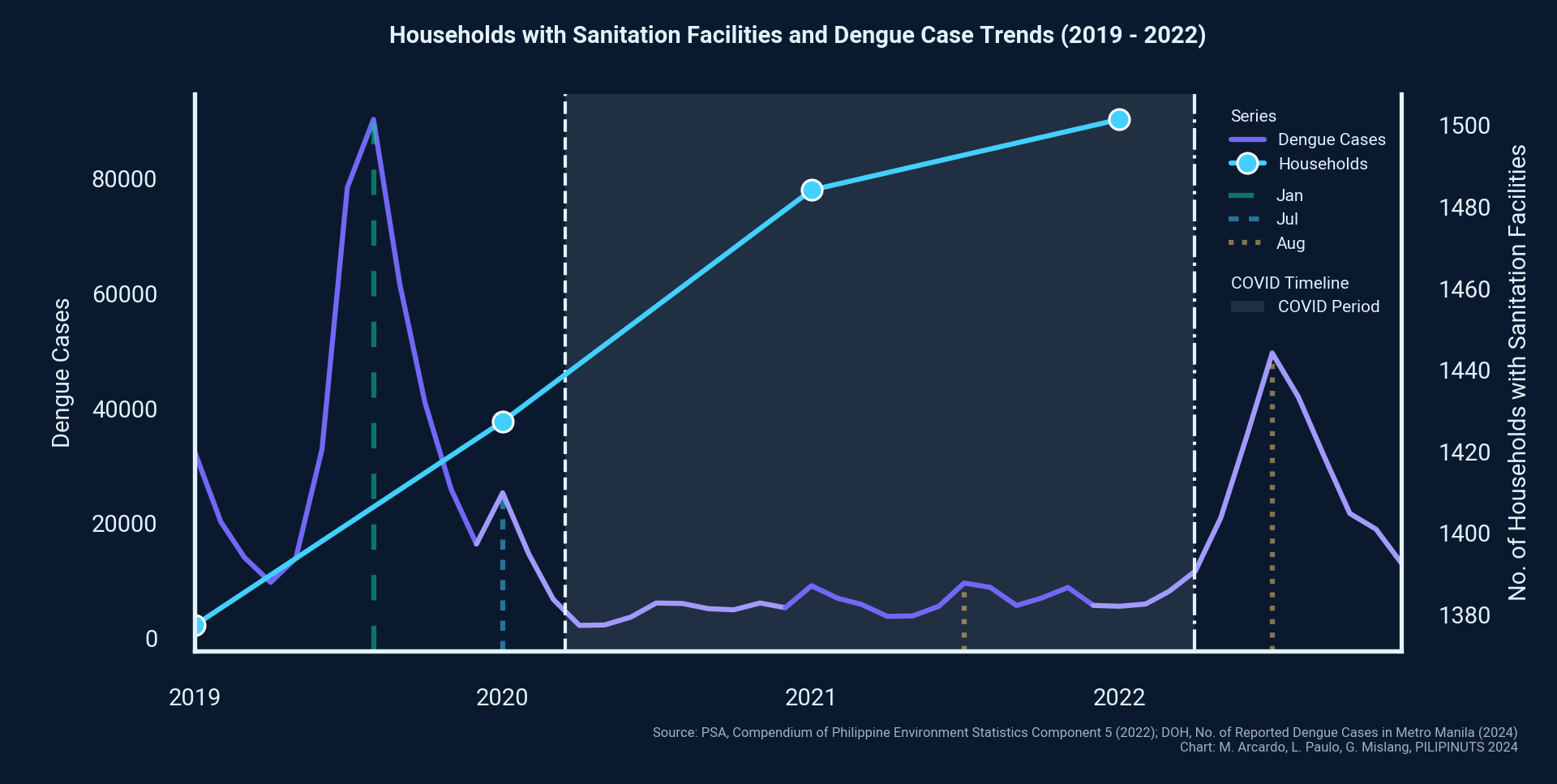
The plot explores the relationship between the yearly number of households with sanitation facilities and monthly dengue cases from 2019 to 2022. It addresses two key questions: whether increased sanitation correlates with fewer dengue cases and whether dengue case peaks shift over time.
The blue line represents the number of households with sanitation facilities, showing a steady increase each year, reflecting improvements in sanitation. The purple line tracks monthly dengue cases, with distinct peaks, especially in 2019, followed by a notable decline in subsequent years.
The plot highlights seasonal peaks in January, July, and August. Despite the difference in time frames—monthly dengue data and yearly sanitation data—the plot suggests an inverse relationship, with higher sanitation levels possibly linked to fewer dengue cases. However, other factors may also influence these trends, and sanitation alone may not be the sole factor in controlling waterborne diseases.
Model
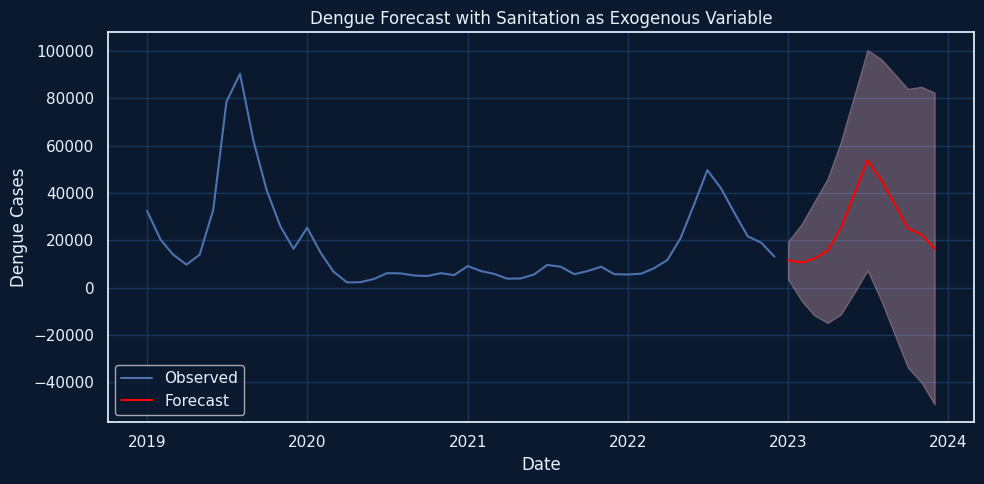
Why the SARIMAX model was chosen
We chose the SARIMAX model due to its ability to handle time series data with both trend and seasonal variables, which aligns with the seasonal peaks in dengue cases as proven by our hypothesis testing. Additionally, SARIMAX supports the inclusion of other variables that could affect the trend in this case, the proportion of households with sanitation facilities.
Limitations of the model
Dengue cases are reported monthly, while sanitation data is only available annually and has to be repeated across months. This limits the model’s sensitivity to short-term changes in sanitation conditions. Furthermore, the coefficient for sanitation proportions was not statistically significant (p = 0.854), indicating that the model did not find strong evidence of a relationship. The presence of high standard errors and a near-singular covariance matrix suggests that multicollinearity or data sparsity may also affect model reliability.
Discussion of model's results
Based on our model's results, it indicated a reasonable fit for a time series of this scale. However, the coefficient for sanitation proportions was large but not statistically significant, implying that sanitation did not have a meaningful impact on monthly dengue cases. On the other hand, the autoregressive term was significant, suggesting that historical values of dengue cases are a strong predictor of future values.
Conclusion
The study focuses on the correlation between household sanitation facilities and the number of dengue cases across all 17 regions of the Philippines. In the dot plot above, it is shown that more than 90% of households have improved sanitation facilities; however, the proportion of dengue cases by population is spread out and shows no clear relationship with the presence of sanitation facilities. Furthermore, the statistical findings in the results section further prove that household facilities have no relationship with dengue cases. A shortcoming of this study is the limited availability of data on household sanitation facilities; only the years 2019 to 2022 were included and correlated with dengue case numbers.
In contrast, a possible explanation is that the breeding grounds of mosquitoes and their mode of disease transmission occur outside of household facilities. Sanitation facilities of individual households are restricted within the boundaries of their homes, making people vulnerable to diseases as soon as they step out of their houses (Stoddard et al., 2012)
To better understand the nature of the disease, the multi-line graph shows the peak month of dengue cases each year over these four years and was also examined to observe seasonal trends. In August of 2019 and July of 2021 and 2022, dengue cases peaked. This coincides with the start of the rainy season in the Philippines, potentially creating breeding grounds for mosquitoes and increasing their numbers (Seposo et al., 2024)
However, in 2020, the peak season for dengue cases occurred in January. This was due to the sudden COVID-19 lockdown, which forced people to stay indoors, thereby lessening the risk of dengue infection. The pandemic had unintended consequences on dengue transmission. While reduced mobility might have led to fewer outdoor breeding grounds, it also led to a decline in routine public health surveillance and vector control programs. This dual effect—reduced exposure and weakened disease control—likely contributed to the irregular peak of dengue cases in January 2020.
The dataset used in this study presents a limitation to the findings. A longer period is recommended to more accurately analyze the relationship between household facilities and the incidence of dengue in the country. Moreover, several other factors may have influenced the results. For example, the COVID-19 pandemic in 2022 may have affected dengue case numbers due to population lockdowns and movement restrictions. It is also recommended to explore other contributing factors to the disease, such as modes of transmission and other waterborne disease variants.
Meet The Team

Mikel Reinan B. Arcardo
2nd Year BS CS Student
My interests lie in developing practical applications, from mobile apps to websites, especially those that enhance my daily life. In my free time, I love to play first-person shooter games, jogging, and basketball, though my usual preferred activity is getting restful sleep.

Lian Nicoli M. Paulo
2nd Year BS CS Student
I like programming since high school, but college made me regret that decision. You can contact me in my email below and a simple, "How are you?" can make my day better. My other hobbies include reading mangas and manhwas or playing badminton if I have free time.

Gabriel M. Mislang
2nd Year BS CS Student
I have a passion for developing nonsense to useful Python applications, ranging from web scraping tools to creating a lazy autoclicker, and I love sharing them on Github. When I’m not coding, you can find me playing guitar, bass, and harmonica, as well as diving into photography and videography! Still a work in progress, but that’s the fun part!